Navavas Village (Danta, Gujarat): Complete Guide,
October 14, 2026

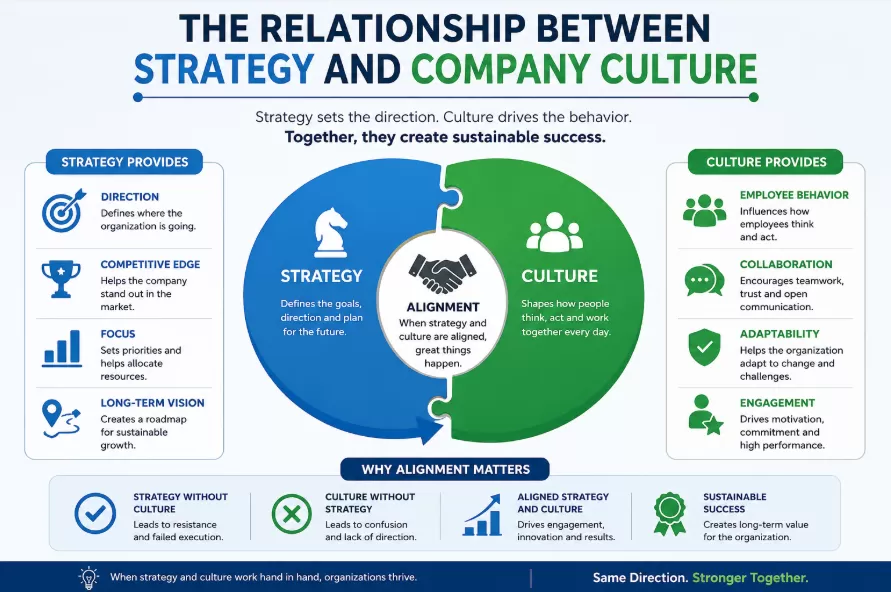
A company’s strategy defines where the organization wants to go, while its culture influences how people work together to get there. Although strategy and company culture are different concepts, they are closely connected and can strongly influence an organization’s success.
A well-designed strategy can fail if the company culture does not support it. Similarly, a strong company culture can become a competitive advantage when it reinforces the organization’s strategic goals. Research and management literature increasingly emphasize that strategy and culture need to work together rather than being treated as separate areas.
Company strategy is the long-term plan an organization creates to achieve its goals and compete effectively.
It typically answers questions such as:
What does the company want to achieve?
Which customers does it want to serve?
What products or services will it offer?
How will it compete in the market?
What resources and capabilities are required?
What priorities should employees focus on?
For example, a company may develop a strategy focused on innovation and rapid product development. To successfully execute this strategy, employees may need to experiment, share ideas, accept reasonable failures, and collaborate across departments.
This is where company culture becomes important.
Company culture refers to the shared values, beliefs, behaviors, expectations, habits, and working practices that influence how people behave within an organization.
Culture can be seen in everyday activities such as:
How managers communicate with employees
How teams make decisions
Whether employees feel comfortable sharing ideas
How the company responds to mistakes
How employees collaborate
How performance is recognized and rewarded
How leaders behave when facing difficult situations
In simple terms, culture represents “how things are actually done around here.”
Importantly, the culture written in company documents may not always match the culture employees experience every day. Effective culture-strategy alignment therefore requires organizations to examine actual behaviors, routines, and management practices rather than relying only on stated values.
The relationship can be understood simply:
Strategy determines the direction, while culture influences the organization's ability to move in that direction.
Imagine a company announces a strategy to become more innovative. However, employees are punished whenever an experiment fails, managers reject new ideas, and departments rarely share information.
The strategy says “innovate,” but the culture says “avoid risk.”
In such a situation, the strategy is likely to face resistance.
On the other hand, if employees are encouraged to experiment, leaders listen to new ideas, teams collaborate, and learning from failure is supported, the culture reinforces the strategy.
Therefore, strategy and culture need to be aligned.
A strategy is only valuable when an organization can execute it.
Even an excellent strategic plan may struggle if employees' everyday behaviors contradict the organization's objectives. Organizational research has highlighted that implementation can become disconnected from cultural realities, creating difficulties during strategic change.
For example, suppose a business wants to provide exceptional customer service.
Its strategy might include:
Faster customer support
Personalized service
Improved customer communication
Quick resolution of complaints
But if employees are evaluated mainly on how many calls they complete rather than how effectively they solve customer problems, the culture and performance system may work against the strategy.
The company must therefore ensure that its culture, leadership practices, incentives, and processes support the desired customer experience.
Employees do not follow strategy simply because it appears in a presentation or company document.
Their everyday behavior is influenced by what the organization actually rewards, encourages, tolerates, and discourages.
For example:
Strategic goal: Become more innovative.
Supporting culture:
Employees can suggest new ideas.
Managers encourage experimentation.
Teams collaborate.
Reasonable failures are treated as learning opportunities.
Innovative contributions are recognized.
When these behaviors become normal, the culture helps turn strategy into action.
Leadership plays a major role in connecting strategy with culture.
Leaders communicate strategic priorities, but their actions often have an even stronger influence on employees.
If a CEO says that collaboration is important but rewards managers who protect their own departments, employees quickly understand the real priority.
Similarly, if leaders want employees to focus on customers, they should demonstrate customer-focused decision-making themselves.
In other words:
Employees often learn the company's real strategy by observing what leaders consistently do—not simply what leaders say.
Strategy and culture also influence the type of employees a company needs.
Suppose a technology company wants to compete through innovation. It may need people who are:
Curious
Creative
Adaptable
Comfortable with change
Strong collaborators
Willing to learn new technologies
Recruitment, onboarding, training, and professional development should reinforce these characteristics.
Human-resource practices are therefore an important link between organizational strategy and culture. Research on strategic HR management specifically identifies organizational culture as an important factor in connecting strategy, people, and organizational effectiveness.
One of the easiest ways to understand company culture is to look at what gets rewarded.
Consider two companies.
The company says teamwork is important, but promotions are based almost entirely on individual achievements.
The company rewards employees for:
Helping colleagues
Sharing knowledge
Solving problems collaboratively
Supporting team goals
Company B is more likely to develop a culture that supports collaboration.
This demonstrates an important principle:
What an organization rewards can shape the behaviors that become part of its culture.
A strong culture is not merely about creating a pleasant workplace. When it is closely connected to the company's strategic capabilities, it can become difficult for competitors to copy.
A competitor can copy a product, pricing model, or marketing technique. But reproducing another organization's deeply established behaviors, relationships, knowledge-sharing habits, and leadership practices can be much more difficult.
This is one reason researchers have examined strategy-culture fit as a potential source of sustained competitive advantage.
Poor alignment can create several problems.
Employees may resist strategic initiatives when the proposed changes conflict with established habits and expectations.
Teams may understand the strategy but struggle to translate it into everyday actions.
Different departments may interpret the company's priorities differently.
Employees can become frustrated when leadership communicates one set of expectations while organizational systems reward different behaviors.
<span style="font-size: medium; font-family: 'ti

October 14, 2026

October 14, 2026

October 14, 2026

October 14, 2026

October 14, 2026

October 14, 2026

October 14, 2026

October 14, 2026

October 14, 2026

October 14, 2026
No comments yet. Be the first to comment.