7 Top Companies Hiring Freshers in 2026 | Apply No
October 8, 2026

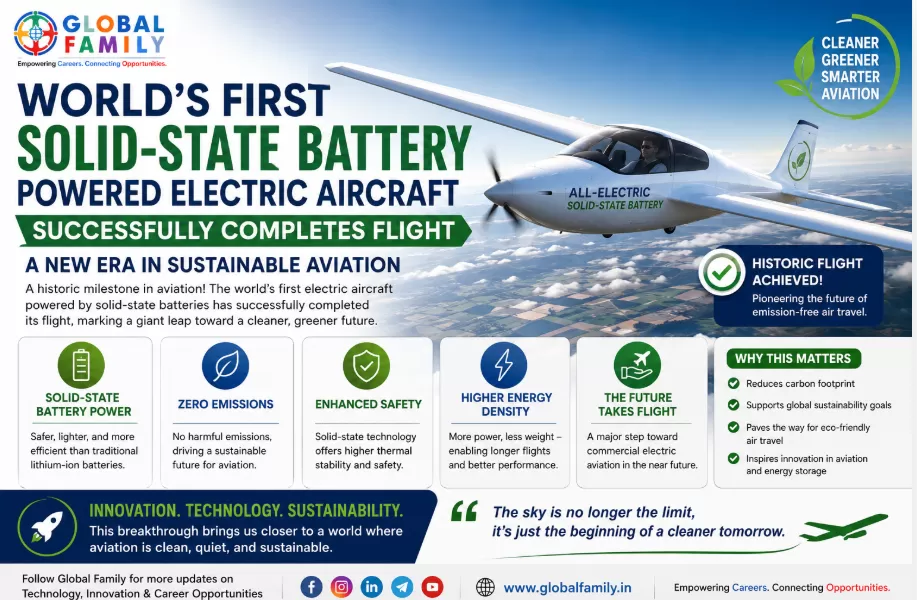
The aviation industry has taken a major step toward a cleaner and more sustainable future. In a historic achievement, a solid-state battery-powered electric aircraft has successfully completed its maiden flight, marking a significant breakthrough in electric aviation technology.
This revolutionary aircraft, developed by innovators in the aerospace sector, demonstrates how next-generation battery technology can transform air travel by reducing emissions, improving safety, and increasing energy efficiency.
For decades, the aviation industry has been searching for alternatives to fossil-fuel-powered aircraft. While electric vehicles have become increasingly common on roads, the challenge of powering aircraft with batteries has remained difficult due to weight limitations and energy requirements.
The successful flight of a solid-state battery-powered electric aircraft represents a major milestone because it uses advanced battery technology capable of storing more energy while maintaining a lighter and safer design.
Experts believe this innovation could accelerate the transition toward zero-emission aviation and help reduce the environmental impact of air travel worldwide.
A solid-state battery is a next-generation energy storage technology that replaces the liquid electrolyte found in traditional lithium-ion batteries with a solid electrolyte.
These benefits make solid-state batteries particularly attractive for aviation, where weight, safety, and efficiency are critical factors.
According to reports, the electric aircraft offers several impressive capabilities:
The aircraft is capable of operating at altitudes of approximately 48,000 feet, demonstrating the potential of electric propulsion systems for advanced aviation applications.
The solid-state battery technology delivers significantly higher energy efficiency compared to conventional lithium-ion battery systems, allowing longer flight durations and improved performance.
One of the most promising features is the ability to recharge quickly, reducing downtime and increasing operational efficiency for future commercial applications.
Electric aircraft produce zero direct carbon emissions during flight, helping combat climate change and reducing the aviation sector's environmental footprint.
The aviation industry contributes significantly to global greenhouse gas emissions. As governments and organizations worldwide work toward sustainability goals, electric aviation is becoming increasingly important.
Electric aircraft can help:
Advanced battery technologies may eventually lower:
The success of solid-state battery aviation demonstrates how innovations in battery technology can influence industries beyond automobiles and consumer electronics.
Despite this breakthrough, several challenges remain before electric aircraft become widely adopted:
Solid-state batteries are currently more expensive to manufacture than traditional lithium-ion batteries.
Airports will require charging stations and supporting infrastructure to accommodate electric aircraft operations.
Researchers and manufacturers must continue improving battery capacity and flight range to support larger passenger aircraft.
New aviation technologies must undergo extensive testing and certification before entering commercial service.
Industry experts predict that electric aircraft could initially be used for:
As battery technology continues to improve, larger commercial passenger aircraft powered by electricity may become a reality in the coming decades.
The successful flight of a solid-state battery-powered aircraft signals a transformative moment for aviation. Major aerospace companies, startups, and governments are investing heavily in sustainable aviation technologies.
With increasing focus on reducing emissions and achieving carbon neutrality, electric aircraft powered by advanced batteries could become a cornerstone of the aviation industry's future.
The successful maiden flight of the world's first solid-state battery-powered electric aircraft marks a significant breakthrough in aerospace innovation. By combining advanced battery technology, improved safety, higher efficiency, and zero-emission operation, this achievement brings the dream of sustainable aviation closer to reality.
Solid State Battery Aircraft, Electric Aircraft News, Sustainable Aviation, Electric Aviation Technology, Battery Powered Aircraft, Future of Air Travel, Green Aviation, Aerospace Innovation, Electric Plane Technology, Aviation Industry News 2026.
While challenges remain, the future of electric flight looks promising, and solid-state batteries may play a crucial role in shaping the next generation of aircraft and transforming global air transportation.

October 8, 2026

October 8, 2026

October 8, 2026

October 8, 2026

October 8, 2026

October 8, 2026

October 8, 2026

October 8, 2026

October 8, 2026

October 8, 2026
No comments yet. Be the first to comment.